Why Some Productivity Systems Don’t Work for ADHD Minds
NB: This is the case for all of the ADHDers I have met and spoken to but it may be that some ADHDers do not have this mindset.
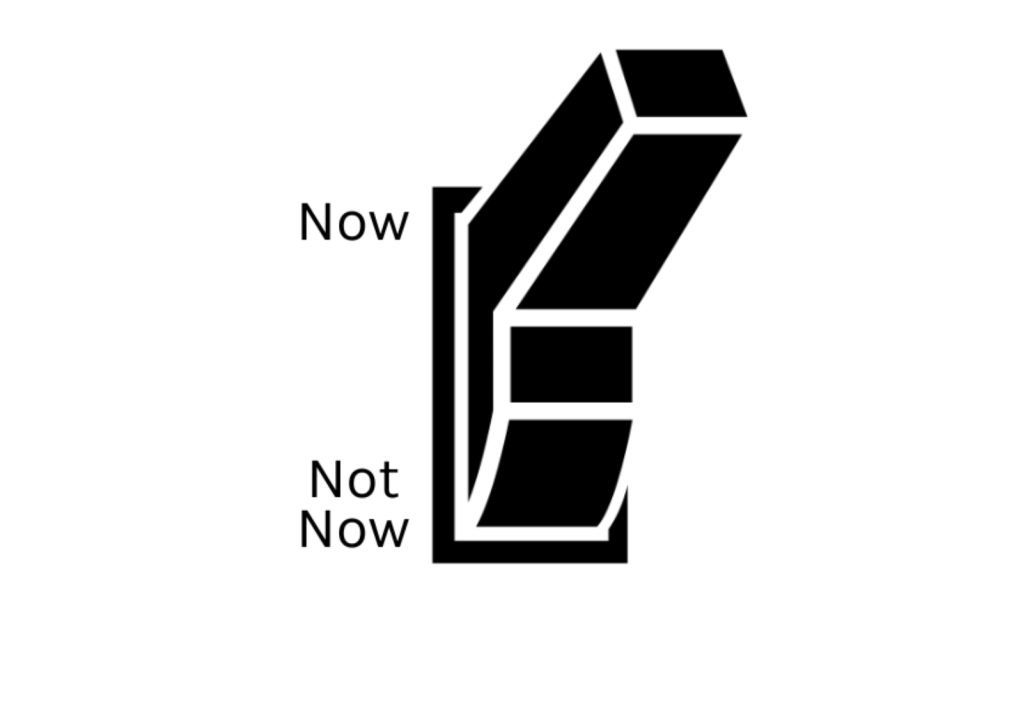
You may have encountered the infamous “Now/Not Now” mindset (2021, Hallowell & Ratey) For ADHDers, time isn’t linear. Tasks don’t slot neatly into to-do lists or schedules—they exist in just two states: “Now” or “Not Now”.
When something is “Now,” it (usually*) commands our full attention, sometimes to the detriment of everything else. It’s urgent, immediate, and impossible to ignore. But when it’s “Not Now,” it fades into the background, no matter how important or time-sensitive it may be. This binary way of perceiving time can make traditional productivity systems feel like they’re not designed for us.
* Even when something is “Now”, if it is boring, stressful or if we don’t have all of the information we still might not be capable of completing the task.
The Problem with Most Productivity Systems
Most systems—whether it’s bullet journals, rigid schedules, or apps—assume we can prioritise, plan, and execute tasks in a predictable way. They’re built for linear thinkers who can:
- Visualise the future clearly.
- Assign urgency and importance to tasks effectively.
- Stick to routines and schedules without constant recalibration.
But for ADHDers, the gap between knowing what needs to happen and doing it can feel insurmountable. Tasks that are “Not Now” simply don’t show up on our mental radar, no matter how carefully we’ve planned them out.
Why This Matters
This disconnect often leads to feelings of failure and frustration. When the system fails us, it’s easy to believe we’re the problem. The truth is, we’re not broken—those systems just weren’t built for how our brains work.
A Better Way: Designing for Now/Not Now
To create systems that actually work, we need to embrace this way of thinking and design around it:
- Capture the “Not Now” Tasks: Use a trusted system (voice notes, sticky notes, a simple app) to quickly jot down things that aren’t “Now” but need to stay visible.
- Revisit Daily: Build in a quick daily review to re-assess whether “Not Now” tasks are becoming “Now.” Don’t over-plan; just check in.
- Work with Momentum: When something becomes “Now,” dive in! Use that energy and focus without guilt and enjoy the dopamine of getting things done.
- Keep It Flexible: Systems for ADHDers must bend to our brains—not the other way around.
Update 20th January 2025
One of the challenges of productivity systems as an ADHDer is getting overwhelmed and having to start again.
This weekend I was at GovCamp in London and so had a finite amount of time to achieve certain things to prepare to travel, make sure I had everything I needed etc.
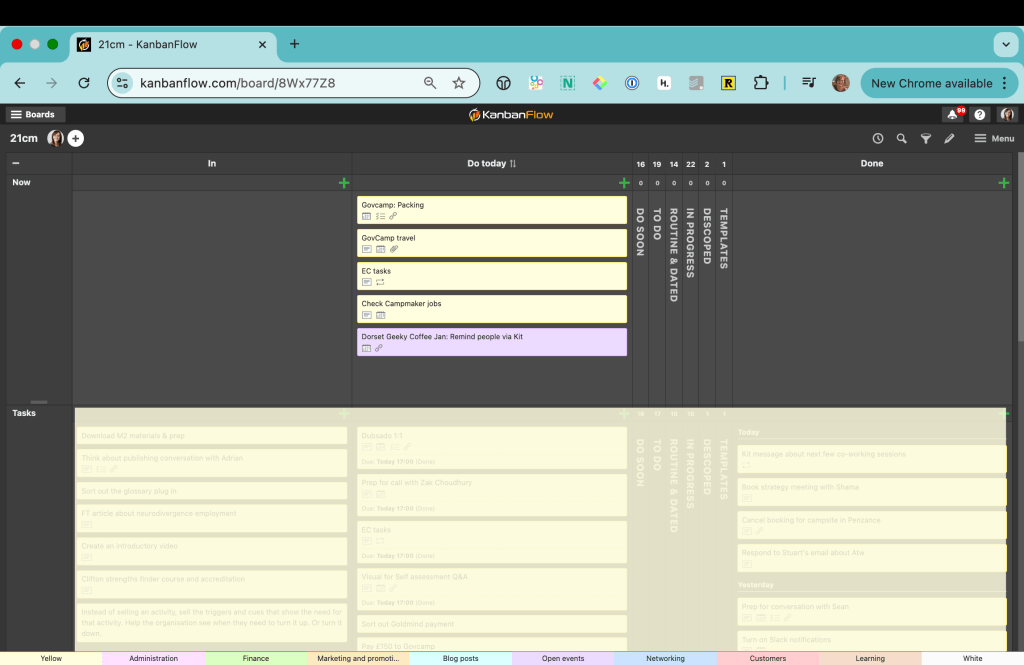
I am using Kanbanflow for tasks at the moment and I easily added another swim lane at the top of my board and used it for things which needed to be done NOW. Of course the columns also show me the priorities but I found adding the swim lane was a really good way of creating clarity.
What else?
Once you have a working task management system you may still need ways to motivate yourself to complete them. In the past you might have managed to get things done by leaving them until the last minute but this can lead to burnout and is not as easy when you get a little older.
Some of my favourites are :
- Body doubling
- Accountability with someone (usually my coach)
- Having a small list for the “Now” tasks and using the dopamine hit of ticking it off or moving it to done
You’re Not Alone
If traditional productivity tools feel like a constant battle, know this: it’s not you. There’s no one-size-fits-all solution for ADHDers, but by leaning into how our brains naturally work, we can find tools and techniques that help us thrive.
It is also likely that something which has worked in the past will stop working for our interest wired brains.
If you would like help to design your own system you could:
- subscribe to my newsletter to see all of my posts
- join me for a group design session [join waitlist]
- book a discovery call about your needs to see if I can help you with 1:1 coaching.
Hallowell, Edward M., and John J. Ratey. ADHD 2.0: New Science and Essential Strategies for Thriving with Distraction – from Childhood Through Adulthood. New York: Ballantine Books, 2021.

 pixlz
pixlz 
Leave a comment